
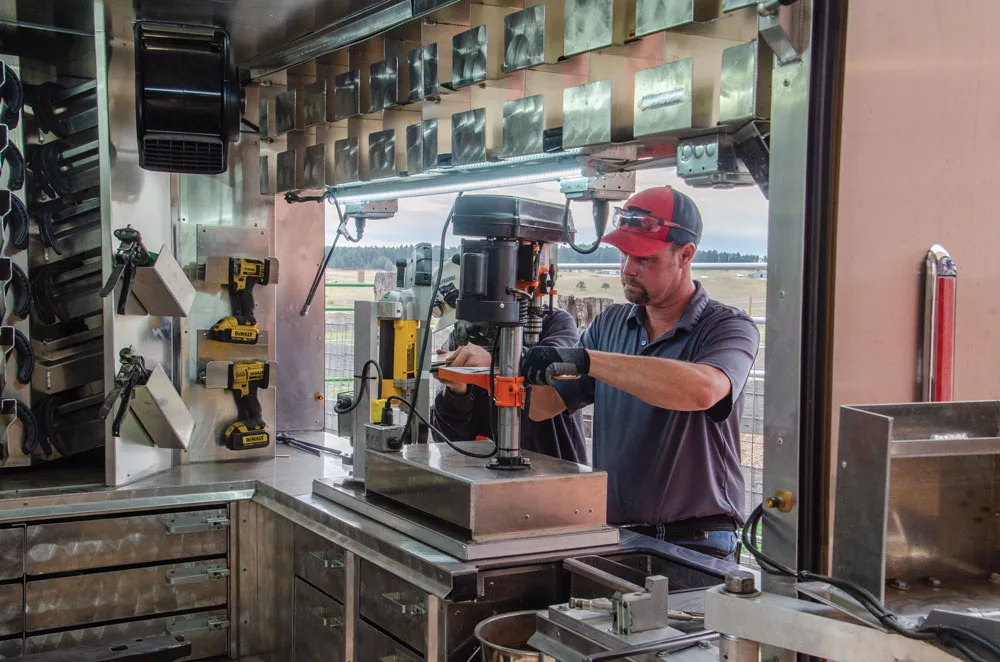
As Peyton, Colo., farrier Chase Rutledge gets his tools organized for the day, his helper Donivan Mitchell, who is in the early stages of learning the trade, cuts the clinches on the first horse of the day.
“Helpers start off just setting up the rig and figuring out where things are,” he says. “At the same time, we start pulling shoes, pushing clinches and doing some finishing. Once they show some confidence in that, I start having them do some barefoot trimming on easy horses. Generally, within a year or two, I’d like them to be capable of shoeing horses, applying clipped shoes and handmaking shoes.”
He also encourages apprentices to work toward their AFA certified farrier examination within 2 years. As horsemanship and farrier skills improve, Rutledge passes them work so they can build the foundations of their business independently from him.
With a previous apprentice, Natalie Smith, he and other local farriers tossed her challenging cases — largely outside her skill level — to push her to excel. If she made a mistake, they could still jump in to help if needed. Some were also laminitic horses likely to be euthanized, he says, so it was difficult to make the situation worse.
“It’s amazing how much better she got because of it,” he says. “She figured it out most of the time, and it made her super handy. Now, she’s only 5 years into this, and she’s working at show barns and continuing her education with other farriers. She’s certified with the AFA, and she’s become quite the success around here.”
Rutledge takes a similar stance with competition. Previously, he didn’t like the idea of competing over a live animal. The horse is the judge, he says; however, there’s a lot that farriers can learn by putting themselves on the spot and being willing to be judged in front of their peers.
After Mitchell finishes, Rutledge picks up a hind foot. This mare has flat soles with a negative plantar angle, so the foot grows more toe than heel. Compared with previous shoeings, the feet have improved.
“Her hoof walls used to be super brittle and weak. Just by trimming close to a 50-50 toe-to-heel ratio, paying attention to the shape of the foot and not over-trimming the sole, I found that her feet have gotten much stronger and more capable,” he says.
That 50-50 ratio is part of the ELPO hoof mapping protocol, which hinges on the idea of centering the hoof around the widest part of the foot and minimizing distortion. It is thought that the widest part of the foot is a close reference to the center of rotation of the coffin joint. He’s found that while not every foot naturally fits these proportions, it’s a good approximation of balance. Though he aims to achieve a balanced foot with each shoeing, he’s gotten much more conservative in his trim as his career has progressed. A horse’s environment, job, activity levels and health can affect how much or how little he takes from the bottom of the foot.
With the shoe off, Rutledge notes the angle of the frog plane compared with the sole plane. Because the frog plane is angled differently than the sole plane — deeper at the apex and more shallow at the frog buttress — he can deduce that the coffin bone is higher up in the toe and lower in the heel, informing him that he needs to trim the toe down to create a more positive plantar angle. These are details that Mitchell is still learning to see and act on.
While having it pointed out is helpful, what can be more effective is doing it yourself.
Hands-On Learning
When Rutledge was an instructor with the ELPO, his students had the privilege of watching or performing up to 50 dissections in a week.
“We’d give eight students five cadavers. We’d map them, and then we’d tear them all apart and see where everything was,” he says. “I could have them actually, legitimately over-trim. If they mapped the foot incorrectly, I could say, OK, let’s trim to that. Let’s see what happens.”
Prior to the Food and Drug Administration’s restrictions on horse slaughter, limbs for dissection were readily available. Rutledge says he would regularly pick up 200-300 legs per class. Without that resource, they got creative. Sequim, Wash., farrier Chris Niclas found a way to make detailed plastic molds of the cadaver feet so that they could be used repeatedly and recreated to make multiple molds of the same foot. That way, multiple people could look at and feel the same foot simultaneously.
“We came up with quite a few different tools to help train students in a short period of time without having to put them under live horses,” he says, another technique he attributes to Niclas. “They learned how to nipper and rasp on a piece of 6-inch PVC pipe. We would nipper rings out, nipper one side down to create angles, and then rasp it flat again.”
This allowed students to get used to a farrier’s stance and build up leg and back muscles while getting a feel for how much pressure it takes to rasp and cut through hoof wall.
“Outside of that, we’d take a 2x6 block of wood, cut it into a circular pattern and have them carve a foot into the block of wood,” he says. “This helped teach them about proportions, overall shape of the foot, concavity of the sole, how to utilize their knives and rasps and to help them see the foot in the wood. Talking to a lot of experienced farriers, they say that no matter what the distortion is in the foot, they can see the ideal foot inside of that.”
Rutledge is more hands-off than some farriers would be with their apprentices. He prefers to let them learn by making their own mistakes, only stepping in to protect the well-being of the horse. With Smith, this meant handing her intimidating cases to encourage her to use and build on her existing skills. For Mitchell, who’s only just beginning, Rutledge might focus on more exercises teaching spatial awareness.
Growing from Failure
At the ELPO, he had students go through what he called a trial by fire. This involved forging a hoof pick after a single brief demonstration. For many, this was one of their first times forging, and the majority of them failed, but it’s what they did with that failure that mattered. Is it motivating or paralyzing?
Rutledge tells the story of two ELPO graduates, one who failed the course and another who excelled. Ultimately, it was the one who initially didn’t pass who became the bigger success as a farrier. That experience lit a fire under her. She pushed herself to learn and do more, while the other farrier coasted on that initial success.
Learning and growing from failure is a mindset that he brings to his own life.
“The reason I failed my first AFA journeyman certification is because I was on my last hind foot, and I didn’t have quite enough steel,” he says. “The examiners could see the point of the heel beyond my shoe. And I’ll give it to them. They tried everything to get that thing shifted and fit. I had no one else to blame but myself. Then I got talking to Dusty Franklin, and he said, ‘I can fix that.’ He throws it in the forge, stretches the heel a little bit and says, ‘There.’
“I never thought about doing that,” he continues. “I’m glad I didn’t pass the first time because I learned different tips and tricks through that failure. That one experience changed a lot of things for me. It was a blessing.
“I also had a couple of previous students with me,” he adds. “Natalie and another student were taking their certified farrier examinations for the first time. I think for them to watch their mentor fail and deal with failure in a positive way was good for them. I didn’t say it was somebody else’s fault, but I also didn’t put myself down. I just said, ‘These are the things they told me I need to work on. That’s what I have to go back and improve.’”
To learn more from Chase Rutledge, read "Colorado Farrier Brings a Fresh Perspective to Hoof Care," in the March 2026 issue of American Farriers Journal.


