 Premium content is for our Digital-only and Premium subscribers. A Print-only subscription doesn't qualify. Please
American Farriers Journal
American Farriers Journal is the “hands-on” magazine for professional farriers, equine veterinarians and horse care product and service buyers.

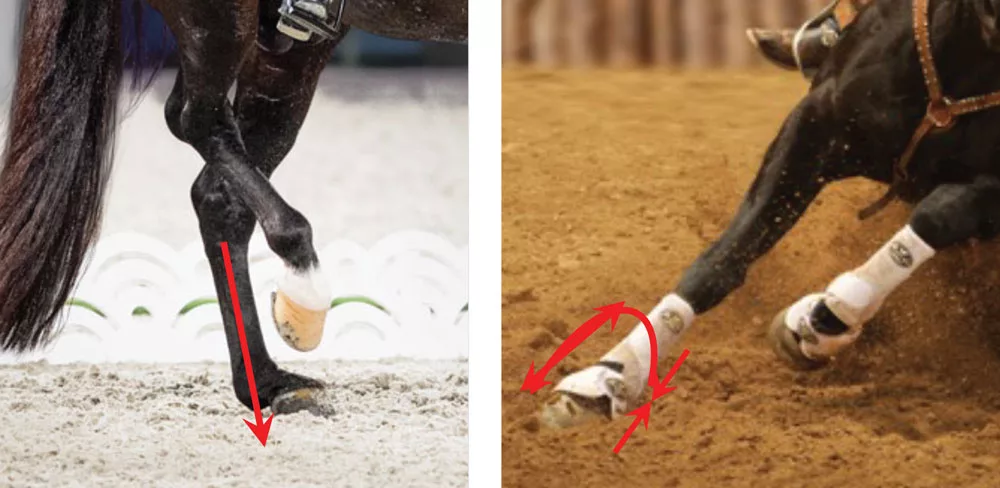
FIGURE 1a and 1b: A dressage horse heavily loads the suspensory ligament, which makes hind limb suspensory injuries relatively common. Barrel horses experience different forces depending on whether the surface is firm, deep or unstable. Platinum Performance
Shoeing strategies during injury recovery play a critical role in determining long-term soundness and reinjury risk. Rather than simply unloading injured structures, farriers must focus on restoring normal elasticity, preserving range of motion and supporting progressive loading during healing.
This shift in approach reflects a growing understanding that elastic function and controlled mechanical stress are essential for proper tendon healing, challenging traditional methods that prioritize comfort alone and fail to address long-term tissue function.
Tendon and ligament injuries do not occur in isolation. They develop as a direct result of the specific forces placed on the limb during movement. Understanding how those forces vary between disciplines, footing conditions and movement patterns is essential when determining how to support the horse during rehabilitation.
As Dr. Matt Durham of Platinum Performance explained during his presentation at the 2026 International Hoof-Care Summit, injury patterns often reflect the mechanical demands of the horse’s job.
“One of the things to think about is that not all tendon and ligament injuries are the same,” Durham says. “A dressage horse, for example, places a tremendous amount of weight on the hind end, heavily loading the suspensory, which makes hind limb suspensory injuries relatively common…

American Farriers Journal is the “hands-on” magazine for professional farriers, equine veterinarians and horse care product and service buyers.

American Farriers Journal is the “hands-on” magazine for professional farriers, equine veterinarians and horse care product and service buyers.
Download these helpful knowledge building tools


We are here to support you.
We stock a wide range of high-quality products from trusted brands to ensure durability, performance, and reliability in every job you undertake. Our extensive inventory of horseshoe products and farrier tools means you can find everything you need in one place, saving you time and effort. Your satisfaction is our top priority. We are committed to providing excellent customer service, prompt shipping, and hassle-free returns.
